An interview with John Hay and Don Schramm of the Rock Springs Grazing Association
By Temple Stoellinger
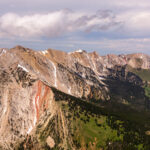
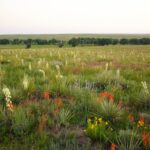
The Rock Springs Grazing Association (RSGA) represents one of the oldest and most complex grazing operations in the American West, born from a conservation crisis more than 100 years ago. The association operates across two million acres of southwest Wyoming’s distinctive checkerboard landscape—a pattern of alternating public and private land sections created by 19th-century railroad grants—which has provided both challenges and opportunities for innovative range management.
In the early days of westward expansion, grazing of public lands was unregulated, and first come, first serve. By the turn of the 20th century, nearly 900,000 head of migrant sheep swept through southwest Wyoming annually, leaving the country “like the top of a desk—nothing left,” as Schramm and Hay describe it. As local ranchers watched their rangeland deteriorate, they recognized that survival required organization and collective action. The fragmented ownership pattern, however, made coordinated management nearly impossible.
Out of these conditions, local ranchers in southwest Wyoming formed RSGA. Rather than competing for access to scattered parcels, local ranchers organized to lease entire blocks of private railroad sections while working to secure federal grazing permits on the interspersed public lands. This strategy gave RSGA control and management authority across large, contiguous areas that no purely private or public operation could achieve.
Within this area, RSGA established its own conservation-based management principles, setting livestock numbers based on carrying capacity rather than market demands and implementing rotational grazing practices to protect the resource. This local, cooperative approach to range management later influenced federal policy. When the Taylor Grazing Act was passed three decades later, the newly formed Grazing Service adopted similar ideas—such as locally administered permit systems and regulated stocking levels—to guide use and stewardship on public lands.
Today, RSGA continues to demonstrate how collaborative management across fragmented ownership patterns can balance conservation, agriculture, and industrial development in the modern West.
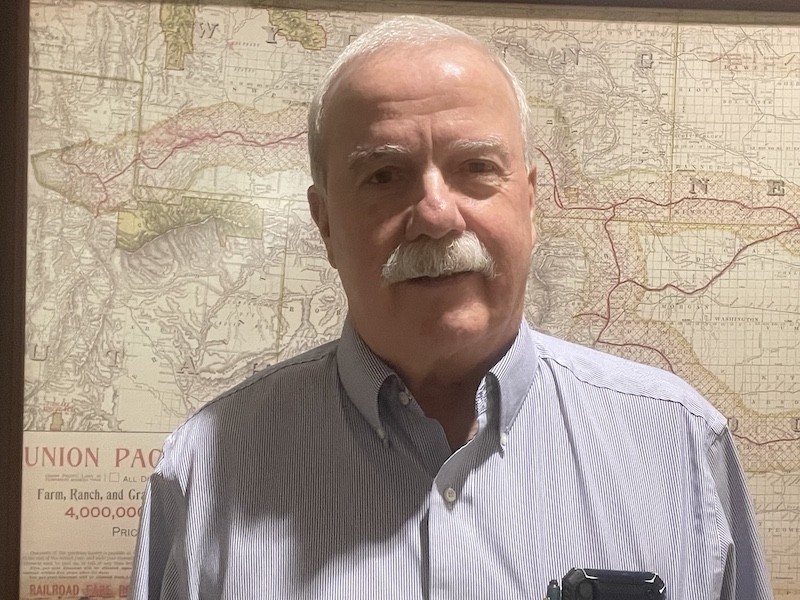 John W. Hay III is a fourth-generation Wyomingite and chairman of RSGA. His family has been integral to the development of Rock Springs for over a century—his great-grandfather, John W. Hay Sr., arrived in the late 1880s as a Union Pacific Railroad supervisor, married into the founding Blair family, and purchased controlling interest in Rock Springs National Bank in 1907. Before joining RSGA, Hay graduated from the University of Wyoming and served as president of Rock Springs National Bank.
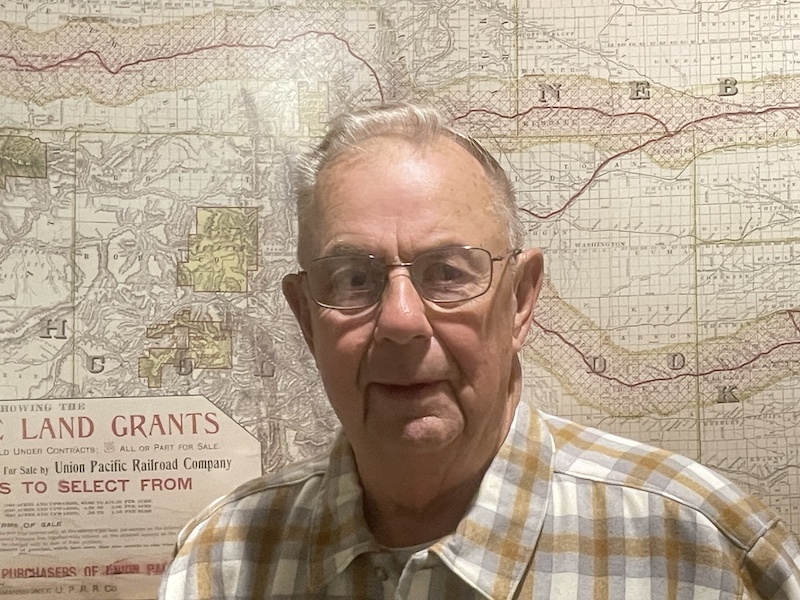 Don Schramm retired from the Bureau of Land Management (BLM) after 37 years as an engineering and operations manager, mostly in Wyoming’s checkerboard regions. He holds a bachelor’s degree in forest engineering from the University of Montana and is a licensed professional surveyor. Currently serving as land operations manager for RSGA, Don reviews, negotiates, and coordinates surface use agreements across nearly one million acres of deeded and leased lands in southwest Wyoming, managing everything from livestock operations to energy development and cell towers.
This interview has been edited for clarity and length.
Western Confluence: How does RSGA manage grazing across such a complex landscape where ownership alternates every other square mile between private and public lands?
RSGA: The checkerboard in the Rock Springs area of southwest Wyoming is roughly 40 miles wide by 80 miles long—about two million acres total. BLM comprises around 48 percent of that, so think of it as roughly a million acres of BLM and a million acres of private and other ownership. Within that private and other million acres, RSGA holds about 520,000 acres, while the other four major owners hold about 480,000 acres. It’s all known as the BLM Rock Springs Allotment—a common allotment encompassing deeded and leased land where we’re the sole holder of the BLM winter permit.
The private land ownership in this area of the checkerboard has become increasingly complex over the years. What was originally federal railroad grant land given to Union Pacific transferred to Anadarko, then Occidental, then Orion. Orion retained two entities: “Aggie Grazing” for everything except trona and “Sweetwater Surface” for the trona portion. Coal properties were sold to Wildcat Coal, while much of the oil and gas remained with Occidental/Anadarko Land Corp. Today, we maintain leases with Anadarko Land Corp, Aggie Grazing, Sweetwater Surface, and Wildcat Coal. There are also other landowners with independent BLM summer grazing permits in the checkerboard that we don’t lease from—the historical arrangement was winter use by us, summer access by them.
Despite this complexity, the key advantage is that we maintain control across the entire two million acres through ownership, lease, or permit arrangements. Managing these large, diverse areas allows us to take a flexible approach that many smaller operations cannot. Unlike some grazing associations that allocate specific use areas to shareholders, we don’t follow that model. We have range on both the north and south sides of the railroad and interstate, and winter conditions vary dramatically between these areas. If your allotment were fixed on the north side and deep snow came in, you’d be stuck. There’s no equitable way to assign fixed areas while ensuring equal opportunity for all shareholders.
WC: How does RSGA coordinate day-to-day winter grazing across the checkerboard?
RSGA: Members coordinate with our range rider, John Pierre Erramouspe. Folks call him to ask where the feed is and what areas make sense. Sheep, being herd animals, can go most anywhere that’s open; cattle aren’t herd animals and need to be in familiar areas where they know feed and shelter. So cattle tend to use parts of the lease they’re accustomed to, while sheep use whatever is open and accessible. Before coming on, most people tour the lease, then coordinate with John about who’s where and what’s sensible.
The lease opens December 1. There’s always a bit of a “race for grass”—people pass good feed to get to favorite spots. We have a fivemile rule that says once you set up in an area, others should give you about five miles of space. It works in concept, not always in practice, especially with cattle mixing. Everyone tries to respect each other, but neither sheep nor cattle read maps. It’s a work in progress every year, and Mother Nature ultimately dictates use. We think this is the best way to manage it so everyone has a fair shot.
WC: How complicated are the legal arrangements that hold this all together?
RSGA: Actually, less complicated than you’d think. We have straightforward lease arrangements with the private companies— basically updated versions of the old Union Pacific forms with some modifications over time. The BLM permit is standard, and we pay based on actual use, not acreage. For state lands, we pay based on their estimate of animal unit months in the leased sections. It could be much more complicated than it is, and it hasn’t changed much over the years.
It’s worth noting that when RSGA was created, there was no federal land control. That didn’t start until the Taylor Grazing Act in 1934, which created the Grazing Service, a predecessor to the BLM. There’s a legend that John Hay’s dad knew Ferry Carpenter, the first director of Division of Grazing, and influenced some of the early rules to follow RSGA practices. That’s just legend, but it’s interesting to think about.
We think the real difference between then and now is in how decisions get made. Back then, local grazing advisory boards assisted the Grazing Service with grazing decisions based on actual on-theground conditions and needs. Today, decisions come from Washington DC, and local BLM offices appears to have very little authority. In our opinion, if you want to improve public lands management, you’d put decision-making back in local hands where people understand the specific conditions and challenges.
WC: What challenges or opportunities does the checkerboard present for your members?
RSGA: The alternating ownership gives us far more usable ground than if we only had private land. In most BLM permits, the BLM portion is the bulk of the ranch’s usable country. For example, in the Pacific Creek Allotment there are about 200,000 BLM acres and maybe 5,000 private, so we have very little leverage there. In the Rock Springs checkerboard, with something close to fifty-fifty ownership, we actually have a seat at the table. That said, our “seat” applies to grazing decisions, not to BLM planning processes, major oil and gas development, or other land-use decisions.
WC: This region has long been shaped by energy development— from coal and oil to trona and renewables. How has energy development intersected with grazing in the checkerboard, and how does RSGA navigate those overlapping land uses?
RSGA: This isn’t split estate like you see around Gillette, where you have private surface over federal minerals. Here, we call it “parallel estate”—federal surface with federal minerals on one square mile, private surface with private minerals on the next. When RSGA purchased the surface estate from Union Pacific, the railroad retained the mineral estate. Because of this pattern, you have to work together. No oil and gas unit can proceed without coordinating with other land managers.
Our philosophy is pro-development and multiple use, and it has worked well. Mineral-related income lets us avoid annual shareholder assessments. While we still charge for grazing, only about half of our shareholders actively run livestock; the others hold their shares for the dividends generated by mineral and surface-use revenues. Oil and gas activity has been extensive over the years, and while livestock numbers have declined, it hasn’t hindered grazing.
Renewables present different challenges, though. Solar requires fencing and becomes single purpose, which conflicts with our multi-use approach, so we say “no thanks” to solar. Wind has a much smaller footprint per megawatt and doesn’t interfere with grazing, so we’re open to discussions. But only with strict conditions that oil and gas development remains the priority, grazing continues uninterrupted, we retain access to all areas, and all existing uses continue. We’re currently negotiating with one company and may talk with another, but it’s challenging to draft agreements that protect our interests while meeting their development needs.
WC: How does RSGA balance livestock grazing with wildlife conservation and increasing recreational use?
RSGA: When the association formed, they thought the country could handle 350,000 sheep. Today, with drought and other resource conflicts, we’re far below that capacity. Deer numbers rose over time but are down now, while elk have jumped dramatically and are approaching wild horse numbers, making it important to manage them at levels the land can support without conflicts. Antelope had a hard winter in 2023 but should rebound; deer may not recover due to elk competition and chronic wasting disease. We meet regularly with Game and Fish on population numbers and targets, and they coordinate with BLM on infrared counts for wild horses and elk.
Conserving the range is the only way any of this works. We keep things in balance, and our livestock numbers aren’t the limiting factor. Remember, RSGA is a winter operation. Plants grow in summer, and we graze dormant vegetation in winter, so winter sheep grazing has negligible impact compared to the greater year-round impacts from wildlife and horses. If summer grazing by anyone overuses the range, that removes winter feed for everyone. We monitor wild horses and elk closely to ensure winter feed remains available for all species, including the pronghorn and deer that migrate through but aren’t here year-round.
On public access, many locals assume it’s all BLM land. To avoid liability, we don’t grant permission, but we don’t deny access either. People hunt and fish. Our private lessors don’t want hunters, though that’s hard to enforce. RSGA and Game and Fish have established management units on about 15 miles of the Green River that are open for hunting and fishing.
Recreation pressure has definitely increased with ATVs, side-by-sides, dirt bikes, cyclists, and backpackers. The numbers aren’t overwhelming, but they’re up. Tools like onX create confusion by showing “BLM roads” that aren’t actually guaranteed public access in our checkerboard, since BLM doesn’t hold easements and counties often don’t either. That’s been a problem, particularly with organized events. Anything commercial on RSGA land requires a permit and insurance, and we tell people to stick to main county roads, not every two-track.
WC: Looking ahead, what are you watching for? What are the biggest challenges facing RSGA?
RSGA: In grazing, ranchers running sheep face major challenges with labor availability and cost. Department of Labor wage requirements now make it hard for operations to pencil out, so I expect sheep numbers will decline from current levels. Statewide, we’ve gone from around six million sheep in 1910 to maybe a quarter million today. This is excellent sheep country but less ideal for cattle in the winter, since cattle aren’t herd animals.
With fewer grazers and more shareholders holding for dividends, we have to work closely with industry—oil and gas, coal, trona, and renewables—so there’s a reason to hold the stock while protecting the resource. Think of RSGA as a large land trust and Wyoming asset where development must be done right. There’s talk of rare-earth mining now. Wind farms can be “here today, gone tomorrow,” so we need solid longterm agreements.
Our current BLM permit is winter only, but if cattle numbers grow and sheep decline, longer seasons in fall and spring might make sense, though that could conflict with summer inholders. We don’t have a perfect scheme worked out yet. We want grazing to continue, though the model may need to change. Some people joke, “maybe we should graze buffalo,” but they’re hard to control and people insist on petting them.
Temple Stoellinger is an associate professor of environment and natural resources and law at the University of Wyoming.